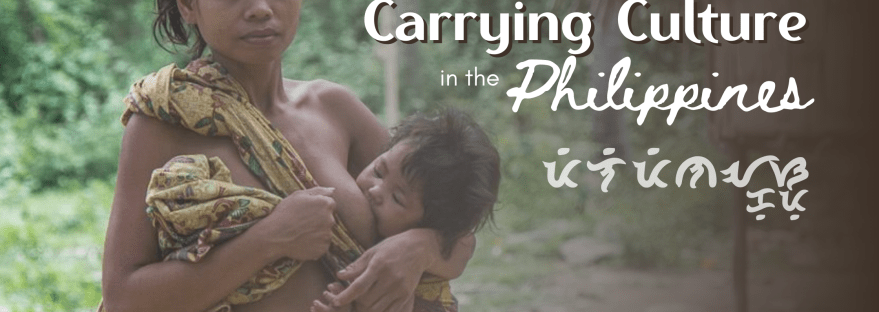
A people without the knowledge of their past history, origin and culture is like a tree without its roots.
Marcus Garvey
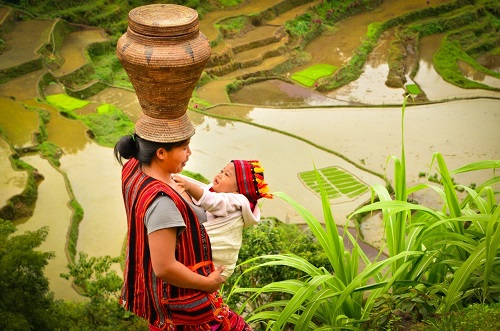
Grand Prize Winner of the 1st JICA Philippine Photography Competition
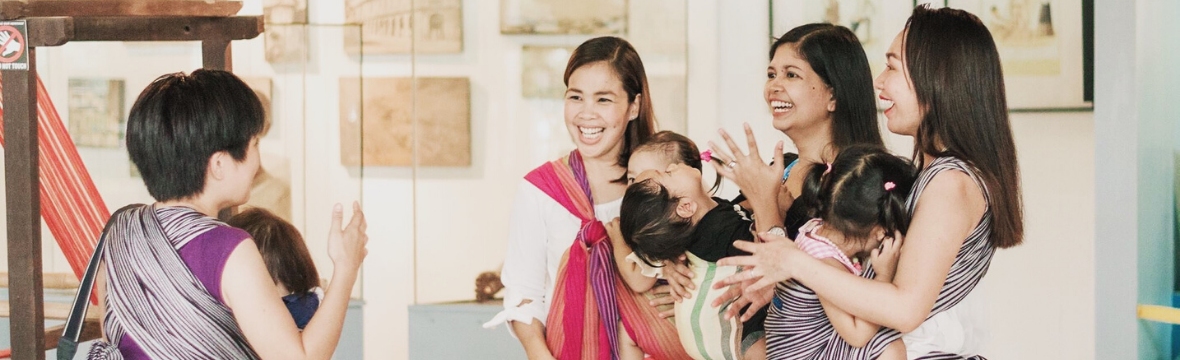
Babywearing has been part of mankind probably since human history began. It is believed that the human species survived because of slings. Slings helped our ancestors travel from one place to another, protect the young from cold weather and predators, provide easy access to the breast, bonding, and more. Through time, this practice, to some was replaced by other rearing tools that, though is used contain and hold the baby, may not help with other factors such as bonding and breastfeeding.
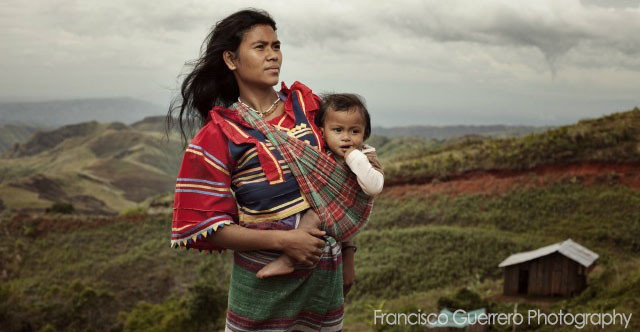
Photo by Francisco Guerrero
Before we dive into our carrying culture, i think it is best to talk first about the Philippines, family dynamics and childrearing practices here in our country
It is highly believed that a country’s geography greatly shapes the culture and the people. With that being said, Philippines is an archipelagic, tropical country that is home to 7, 107 islands (during high tide, and 7,641 islands during low tide). We are composed of more or less 175 ethnolinguistic groups wherein a few hour jeepney ride or a few minute banca trip would mean a greeting from a new language and a somewhat different set of culture. Filipinos are very much proficient in language such that in a lifetime, we can learn several sets of languages – we have the official Filipino language, we have our provincial dialects (mine is Hiligaynon, language used in Iloilo), regional languages (as an Ilonggo, living in the Visayas region, I can understand few Bisaya words), and English (Philippines was the 3rd largest English-speaking country in the world in 2012, BBC reported). Also, nearby provinces do understand the languages of the other, for example, a Pangasinense (Pangasinan) can understand Ilokano (Ilocos). My point is, because we are islands away from each other, as a nation, we are a great mixture of varied culture and traditional practices however, some practices and terminologies though may vary, may actually mean the same thing. It is also worth noting that our indigenous tribes utilize different types of material in their choices of slings like the one used in mountain provinces are thicker than the one used here in the lowlands
To date, we have more or less 40 indigenous tribes all over the country and most of them still utilize their own slings and follow their own carrying practices
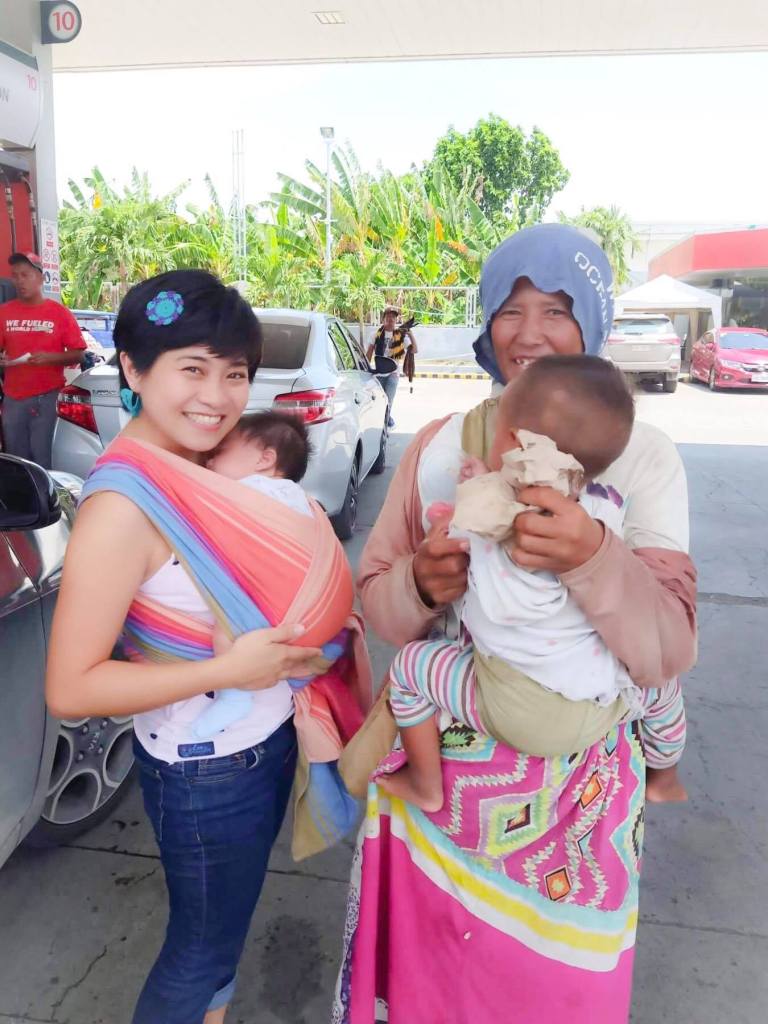
roaming in the streets of Jaro, Iloilo City
Some Filipino values and practices
1. Close family ties
Typical Filipino family set-up is a household where you live with your parents, grandparents, uncles, aunts, cousins, nieces, nephews..this is what we call as an extended family. Sometimes, even, it is being frowned when a new couple would separate from the ‘nest’.
And because we live closely with other family members, caring of the child is being done by almost all of the members — and even during pregnancy, a pregnant mother is being well-taken cared of by all to protect the baby (first and foremost). After birth, a child is never alone, he or she is basically raised by the family. Family is highly attached to the baby that wherever the main caregiver of the hour is, that’s where the baby is expected to be. Babies are practically held close at all times. We practice extended co-sleeping, breastfeeding and babywearing.
2. Bayanihan
Bayanihan is a traditional practice wherein several Filipino men would together lift a bahay kubo (traditional house, a nipa hut) and transfer it to another place to help a new family start a new life. The family on the other hand will prepare a ‘salo-salo‘ (feast) that will be enjoyed by everyone after the transfer. This practice is an evidence that Filipinos love to help one another no matter how difficult and challenging the situation is. I would like to relate this one to babywearing such that, as mentioned earlier, we practice close family ties, in relation to bayanihan, childrearing is done by all family members. A Filipino baby is showered with so much love and affection from all the members of the household. Even older siblings of the baby are already given the responsibility to look after the child. Sometimes, even, children are also gladly being looked after by neighbors. Because of this, a Filipino child grows up with high regard to peer group acceptance and concern for other people especially those at home. We just find joy in helping other people.
3. Hospitality
Filipinos are happy, welcoming people. Knock on a Filipino household and expect to be served with meals on a shiny, beautiful plate from a newly opened box gifted from the wedding few years back (haha!). If you need a place to crash in, we will lay out our best, crisp, fresh-smelling linens for you. We do not like our visitors to feel any inconvenience while they stay in our place. We always want to put on our best foot. How is this even related to childrearing, you may ask. Simple–if we can do a lot for visitors, how much more for our babies? We really try hard to give our best to our children. If we are left with little food, the parent will, no brainer, give it all to the child.
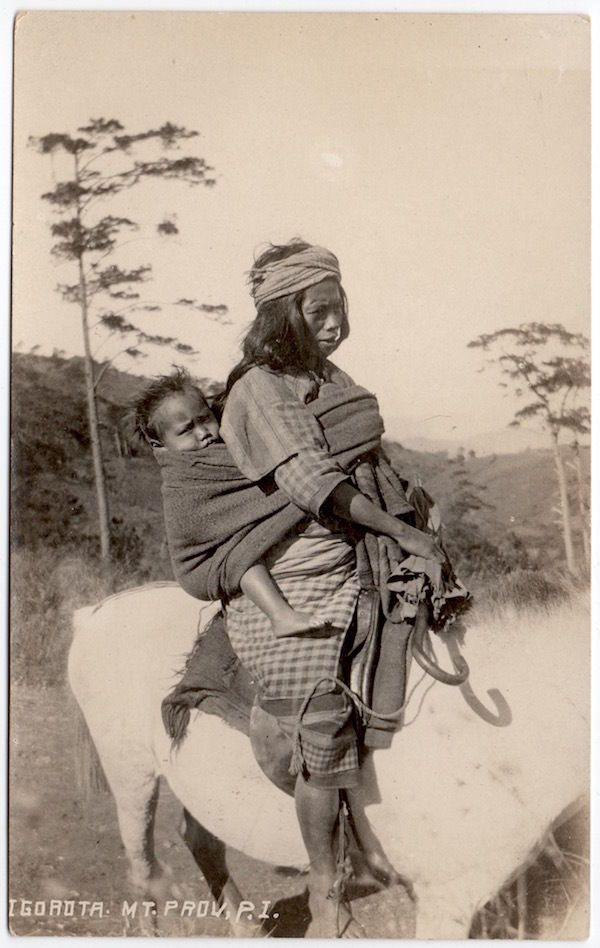
The Carrying Culture – why did Filipinos in the past carry their young?
1. TRANSPORT.
Our ancestors, specifically the Negritos, do not stay in one place. They hop from one place to another to go look and hunt for food. A sling, then, helped them carry their babies as they travel. Even until now, you can still see them carry their babies while they roam the busy streets looking for food scraps and shed to stay for a while.
2. WORK.
Long before Spaniards came and colonized the Philippines for over three centuries, women are regarded as equal to men — women can own a piece of land, has rights to name her child, etc. She is definitely not a subspecies to men. She is not programmed to be confined to the four corners of her home, taking care of the babies and cleaning the house. She is rather given an equal chance to make a living, help in the farm, provide food to the table through her income or fruits of her labor in the field. Because of that, mothers are empowered to bring their child to work–where the little baby is placed on the sling while she is tending the farm, cleaning the house, taking care of the kids. a superwoman, indeed, i should say!
Not only that, other family members bring babies in the field, too, while they work through the help of a sling–fathers, grandmothers, aunts, sisters,.name it!
3. PROTECTION.
Our ancestors believed in ‘anitos’ (gods or spirits) and they fear that when leave their baby alone in the bed, on the floor or on the crib, ‘anitos’ will get their kids. They also fear that field rats and snakes will bite or harm their babies when they leave them lying around the house, so they opted to carry their babies. In mountainous areas, they carry their babies to protect the young from cold.
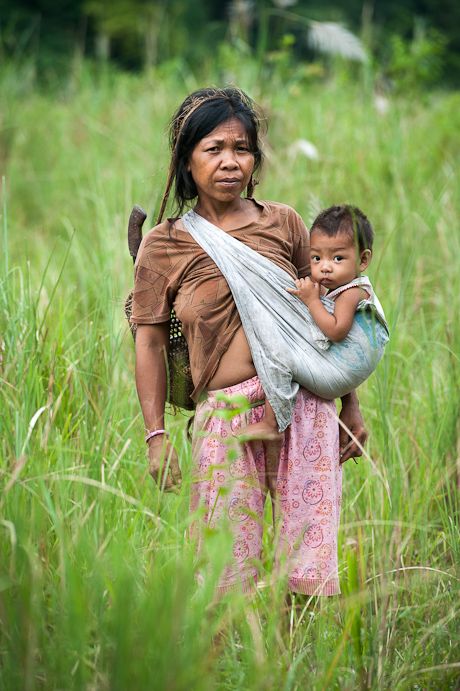
Some Traditional Slings or Carrying Practices
- Aetas use an ‘ubfan’ to carry the child. It is practically any thin blanket, about 2-3 meters in length and less than 1.5m in width. It can be made with any fabric, sometimes they even use katsa or flour sack. They use the hip carry and finish it with a double knot by tying both ends
- Aban or Eban is the sling used in the Northern Philippines.
- Patadyong is a wrap-around fabric or tube-like cotton fabric, usually in plaid design, found in the Visayas that has varied uses. It is somewhat similar to Indonesia’s sarong. Patadyong came from the Hiligaynon word ‘tadlong’ which means straight.
It can be sewn or used as part of clothing, a bag, a hammock, a sling and many more.
- Malong, similar to Patadyong, is mainly used by Filipinos in Mindanao. it is a printed, cotton, tube-like fabric that has a lot of uses from birth to tomb. It is believed that a malong is used to wrap the baby while it is young, will also serve as a sling, a hammock, a blanket, a towel, a bag, a kimono, a jacket, and will also wrap the body when a person dies. As a sling, they just fold the tube to make it narrow, place it diagonally on the body and perform a poacher’s knot to make the pouch well-fitted.
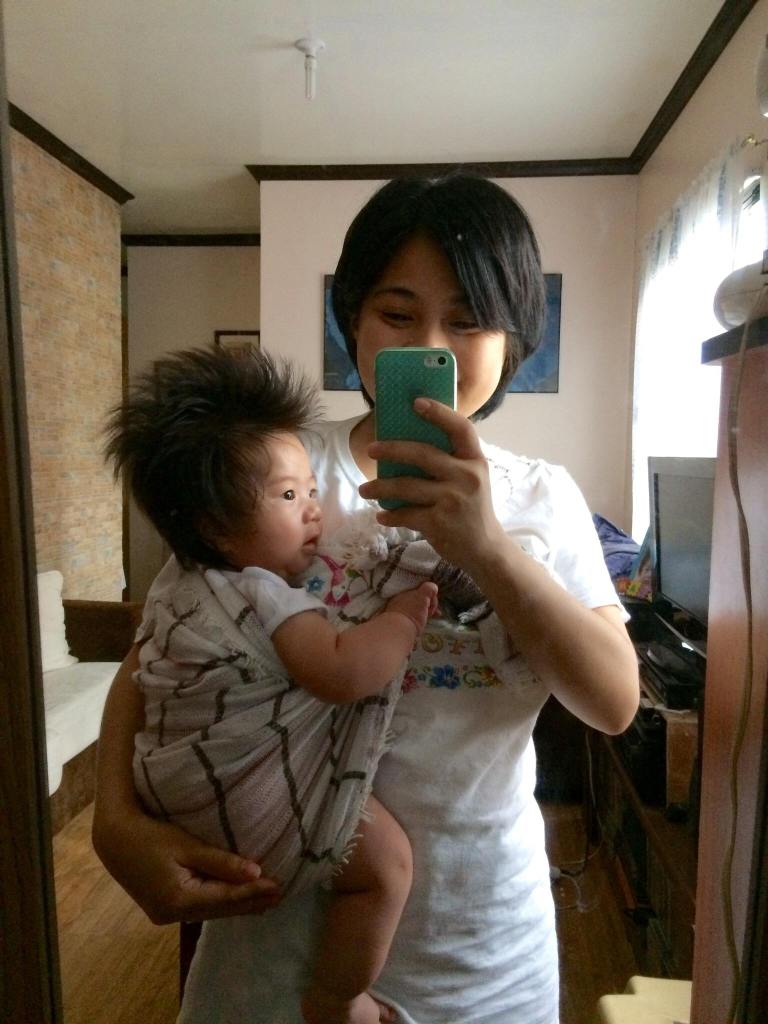
using a blanket in 2016
We still have a lot to learn and discover more about babywearing here in the Philippines and I am going to update this post as soon as I find out more.
How did your ancestors carry babies?
#babywearsmart
 Babywear Smart
Thanks for your research.
Curious on what you will find out about traditional bw in the Philippines (especially Bicol) as you live there.
a root growing seed 😉
LikeLike
Hello, I live in Iloilo City.. 🙂
I will do my best to find information about babywearing traditions in Bicol 🙂
Thank you so much!
LikeLike